
Severe Weather outlook
Storm Prediction Center

-
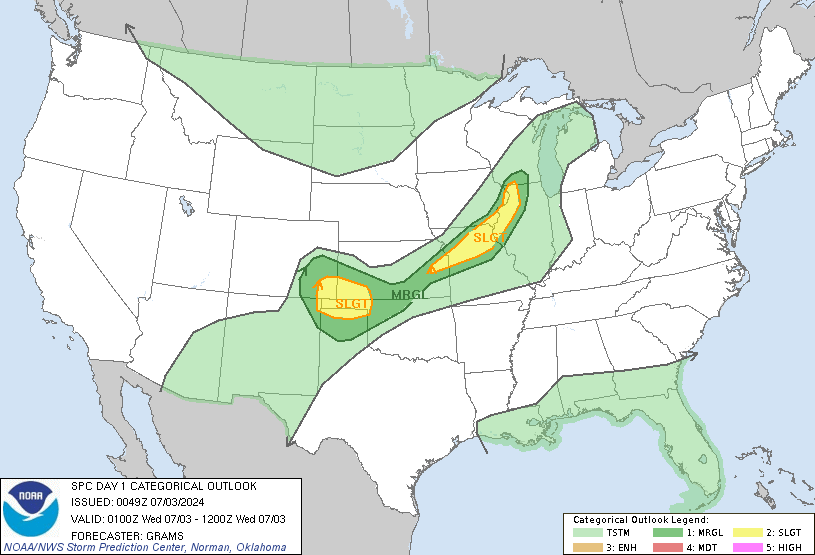
SPC Apr 15, 2026 1300 UTC Day 1 Convective Outlook
SPC 1300Z Day 1 Outlook
Day 1 Convective Outlook
NWS Storm Prediction Center Norman OK
0746 AM CDT Wed Apr 15 2026

Valid 151300Z - 161200Z

...THERE IS A SLIGHT RISK OF SEVERE THUNDERSTORMS FROM THE SOUTHERN
PLAINS INTO THE MIDWEST AND SOUTHERN GREAT LAKES...

...SUMMARY...
Severe thunderstorms posing a risk for large hail to very large
hail, severe gusts, and a couple of tornadoes will be possible
across portions of the southern Plains toward the Great Lakes this
afternoon and evening.

...Synopsis...
Water-vapor imagery this morning shows an upper trough from the
eastern Dakotas south-southwestward into the southern Rockies.  A
few disturbances will migrate eastward coincident with the trough
with the most notable being over the central High Plains this
morning.  The aforementioned disturbance will move east reaching the
mid-upper MS Valley with the trailing southern extent of the wave
moving into the MO Ozarks and OK by daybreak Thursday.  A weak
diffuse low will move from northern KS to the southwest Great Lakes
by late tonight.  Farther east, an MCV near MO-IL will translate
east and become perhaps a focus for storm activity later this
afternoon across OH-PA.  A rather complex forecast is apparent due
in large part to considerable convection and related outflow
permeating the warm sector overnight across much of the Slight-Risk
area.

...Iowa into the mid MS Valley...
In the wake of showers/storms this morning from IA southward into
MO, a moist and weakly capped airmass will destabilize through early
afternoon.  The eastward approach of the mid-level disturbance will
likely contribute towards scattered thunderstorms developing 19-21z
from near the weak low eastward along the composite outflow/frontal
zone into IL-WI and southward into MO within a weakly capped warm
sector.  Forecast soundings show straight-line hodographs over IA
with sizable CAPE in the hail growth zone.  The potential for
splitting supercells appears evident with the stronger storms
capable of very large hail and perhaps some tornado risk across IA
and northern MO.

...Ozarks into Oklahoma and north Texas...
Morning raobs showed steep 700-500 mb lapse rates (7.5-8 deg C/km)
atop a seasonably very moist return-flow airmass.  Models generally
show storm development near the dryline by mid afternoon with
initial development becoming supercellular.  Large to very large
hail will be possible with the stronger updrafts.  Residual outflow
from overnight convection moving into the Ozarks may play a role in
enhancing low-level shear later today.  Forecast soundings show
somewhat limited low-level hodographs with a tendency for a
veer-back-veer signature.  Additional storms will favor some
clustering and upscale growth with time due in part to the forecast
hodographs.  Nonetheless, all hazards will be possible at least
through the early convective life cycle before the possibility for
wind damage and linear structures perhaps evolve during the evening.

...Southern Great Lakes into the Northeast...
The remnants of an overnight squall line are moving east across
NY-PA this morning with a trailing outflow boundary extending
westward into OH and northeast IN.  Moist low levels and the
eastward advection of steeper mid-level lapse rates will act to
destabilize the southern Great Lakes into western PA through midday
and into the afternoon.  Forcing for ascent and enhancement of flow
associated with the MCV will potentially focus thunderstorms and aid
in their organization potential beginning this afternoon.
Considerable uncertainty remains regarding this scenario and whether
a mesoscale corridor of higher tornado probabilities is needed
(i.e., northeast OH).  Will defer to later outlooks to where perhaps
mesoscale corridors of greater wind/hail threat and an isolated risk
for a couple of tornadoes could develop.

..Smith/Dean.. 04/15/2026
Read more